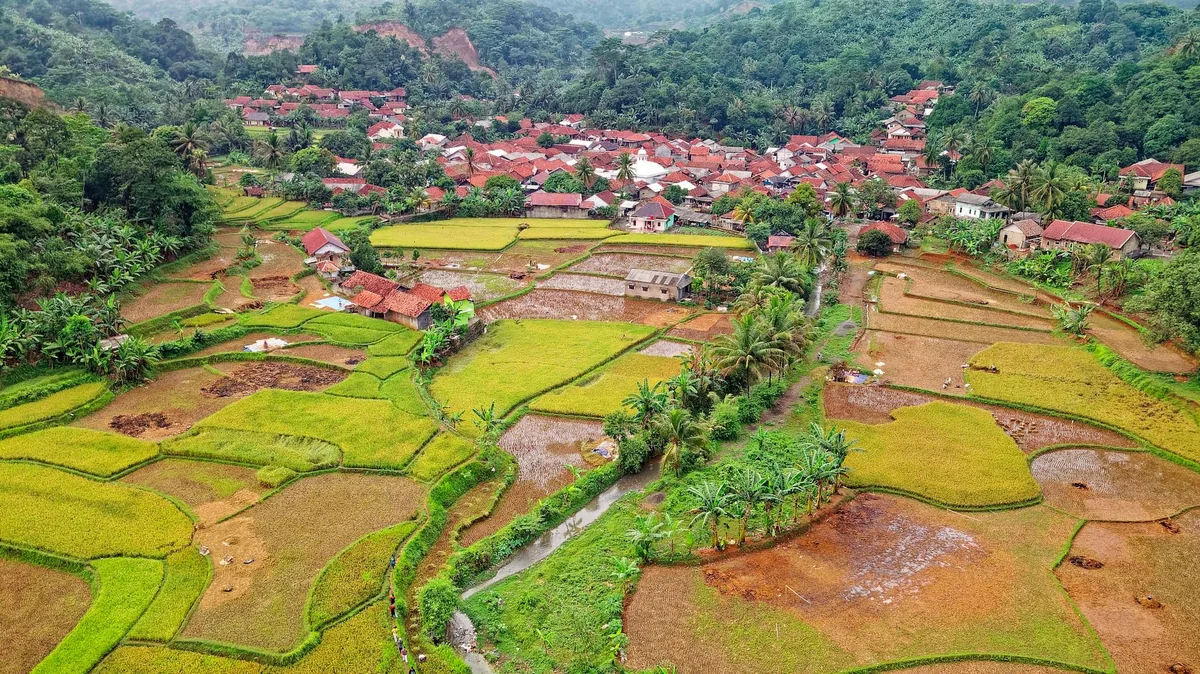
Bena Traditional Village
Bena is the best-preserved Ngada traditional village in the Bajawa highlands, with a ceremonial street lined by ngadhu and bhaga ancestor shrines, stone clan tombs, and thatched houses continuously inhabited for at least 700 years. The village maintains traditional animist rites alongside Catholicism. It is 19km south of Bajawa on a paved road and makes a straightforward half-day trip, with a small entrance donation expected.
Bena sits on a ridge at the foot of Inerie Volcano, with a central plaza containing structures that have stood here for over 1,200 years. The families who live in the traditional houses around that plaza trace their lineage to the founding clans of the village. The ngadhu, a carved wooden pole topped with a thatched parasol, representing the male ancestors of a clan, and the bhaga, a small house-shaped shrine placed beside it, representing the female ancestors, are the paired sacred totems of each clan. They are renewed each generation but never replaced with something modern.
This is not a preserved village. It’s just a village.
The Village Layout
Bena follows a strict spatial logic that reflects the clan hierarchy and cosmological beliefs of the Ngada people. The village is organized linearly along a ridge, with houses on either side of the central plaza. The plaza is not simply an open space, it is a ceremonial ground with sacred significance.
In the plaza:
- Megalithic stone tombs (kubur) at the centre, flat stone platforms where clan ancestors are believed to rest
- Ngadhu-bhaga pairs for each of the nine clans, positioned according to clan rank and origin
- Central stone (peo), a sacrificial post used in specific ritual ceremonies
The houses flanking the plaza are traditional sao structures with thatched roofs, bamboo walls, and elevated floors. Many have been rebuilt over the generations following the original blueprint.
Ngadhu and Bhaga
The defining structures of any Ngada village. Each pair represents one clan’s founding ancestors, male (ngadhu) and female (bhaga), and is renewed in a ceremony (pati ka nage) that can involve buffalo sacrifice and village-wide celebration.
The ngadhu pole is typically carved with specific motifs that identify the clan and its history. The parasol thatch is maintained regularly. When a renewal ceremony occurs, the village celebrates for days. Timing your visit to coincide with a pati ka nage ceremony is unlikely by chance but extraordinary if it happens, ask in Bajawa if any ceremonies are scheduled.
Ikat Weaving
Bena women weave traditional ikat textiles in the shade of the traditional houses throughout the day. The Ngada ikat has distinctive bold patterns in deep red, black, and natural cotton white. You can watch the process, back-strap loom weaving, natural dye preparation, and buy directly from the weaver at honest prices. Factory-made imitations exist in Bajawa shops; what you buy in Bena is the real thing. Prices start at IDR 200,000 for a simple piece, more for complex work.
What Else Is Near Bena Village?
Three nearby villages worth combining on the same half-day:
Gurusina (5 km from Bena): Smaller, fewer tourists, more intimate atmosphere. The ngadhu/bhaga structures are present but the village feels less curated. Recommended as a second stop after Bena.
Langa (3 km north of Bena): Another traditional Ngada village with a more compact layout. Ask in Bena for current conditions.
Nage (10 km east of Bajawa): Known for its stone megaliths and a different sub-group of Ngada culture. Slightly harder to reach independently.
How Do You Visit Bena Respectfully?
Bena is the most visited traditional village in Flores, and the residents feel that pressure. A few things that genuinely matter:
Pay the entry donation: IDR 20,000-30,000 at the entrance. This goes to the village collectively, not to a tour operator.
Don’t walk ahead of your guide: If you hired a guide (recommended), they manage the interaction with residents. Walking into private spaces unannounced is not appropriate.
Photographs: The central plaza, ngadhu/bhaga, and architecture are freely photographed. Photograph individuals only with a visible nod or permission. Some elders in Bena actively prefer not to be photographed and will make that clear.
Buying textiles: Buying directly from a weaver in Bena is the most honest exchange. The price should reflect the labour involved (hours per piece). Don’t bargain down aggressively on handmade work; the weaver’s time is the cost.
Children: Some children in Bena have learned to ask tourists for candy, pens, or money. Handing out individual gifts encourages this behaviour. If you want to contribute, give to the village entry donation or buy from adult weavers.
Don’t touch the sacred structures: The ngadhu and bhaga are sacred objects with active religious significance. Looking and photographing is fine; touching without permission is not.
What Is the Best Way to Plan a Bena Day Trip from Bajawa?
A good Bajawa half-day circuit:
- Morning (7-9 AM): Bajawa market (active by 6 AM, best before 9 AM)
- Mid-morning (9-11:30 AM): Drive to Bena (30 min), spend 1.5-2 hours with a guide
- Late morning (11:30 AM-1 PM): Stop at Gurusina on the way back (30 min)
- Lunch: Back in Bajawa
A full-day version adds the Soa Hot Springs (30 km north, via a different road, 1.5 hours return) and Wogo village. Ask your guesthouse in Bajawa to plan this, they know the current condition of each site and which villages have ceremonies scheduled.
Hired car with driver for the circuit: IDR 300,000-450,000. Ojek circuit to Bena and back: IDR 80,000-120,000.
Frequently asked questions
What is Bena village?
Bena is a traditional village of the Ngada ethnic group, 19 km south of Bajawa on the slopes of Inerie Volcano. It is a living village, real families live here, not a museum. The village is organized around a central plaza containing megalithic structures: ngadhu (male ancestor totems, carved wooden poles with thatched parasol tops) and bhaga (female ancestor shrines, miniature traditional houses). The layout has not changed in over 1,200 years.
How do I get to Bena from Bajawa?
Hire an ojek from Bajawa town center for IDR 30,000–40,000 one way (30 minutes on a paved road). A private car with driver for a half-day covering Bena, Gurusina, and the Soa direction costs IDR 250,000–350,000. Public transport to Bena is infrequent, the ojek or car hire is the practical option.
What are the ngadhu and bhaga structures?
Ngadhu and bhaga are paired sacred objects representing male and female ancestors of each clan. The ngadhu is a carved wooden pole (about 2–3 metres tall) topped with a thatched parasol, it represents the male lineage. The bhaga is a small model house on a low platform, it represents the female lineage. Each clan in Bena has its own ngadhu-bhaga pair. They are maintained continuously; when the thatch or carving deteriorates, a ritual renewal ceremony is held.
Can I enter the houses in Bena?
Some houses are open for visitors to look inside with permission. The interiors are typically one room with a central fireplace, sleeping platforms, and woven storage baskets. Do not enter any structure without being invited or explicitly permitted. The private areas of occupied family homes are not for tourists, a respectful glance inside an open door is different from walking in.
What should I wear to visit Bena?
Dress modestly: covered shoulders, knees covered. A sarong may be provided at the entrance for a small fee, wearing one is appreciated. Remove shoes if entering a house (always follow the host's lead). Photography of the central plaza and ngadhu/bhaga structures is freely permitted. Photograph people only with their permission and willingness, some elders prefer not to be photographed.
Is a guide necessary for Bena?
A guide adds significant value. The symbolism of the ngadhu/bhaga, the clan structure, and the meaning of specific carved motifs require explanation. Local guides from Bajawa charge IDR 50,000–100,000 for a Bena visit. Some villages have informal local guides who explain in Indonesian, useful if you speak some Bahasa. Without explanation, Bena is visually impressive but much of the cultural depth is lost.