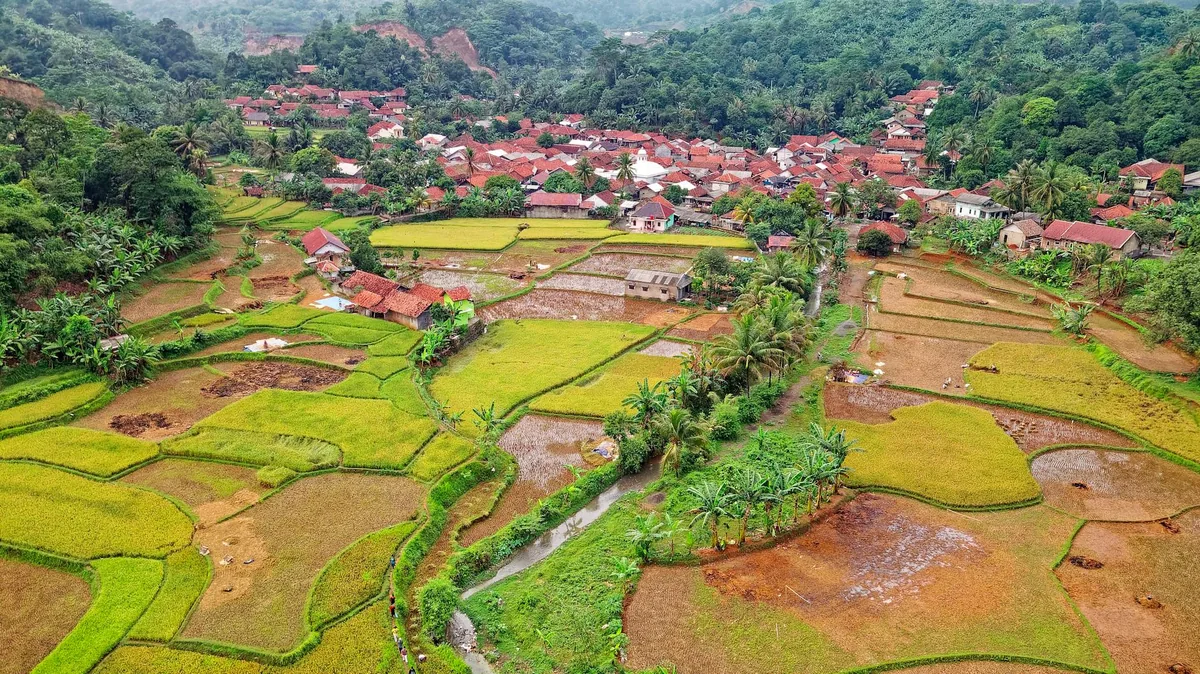
Bajawa
Bajawa is the highland town of the Ngada people in central-west Flores, sitting at 1,100m altitude with cool temperatures and views toward Inerie volcano. The surrounding area contains the best-preserved traditional villages in Flores, including Bena and Wogo, where stone tombs, ngadhu ancestor shrines, and thatched houses surround ceremonial plazas. It is the base for visiting Bena village and an overnight stop on the Trans-Flores Highway route.
Bajawa sits at 1,100 metres in the mountains of central Flores, cooled by altitude and flanked by the perfect cone of Inerie Volcano. It’s the heartland of the Ngada people, a highland ethnic group of central Flores who have kept their traditional villages, clan structures, and ancestor ceremonies largely unchanged for over a thousand years, and the best base for seeing this culture in person.
This is not a tourist destination in the Labuan Bajo sense. There are no rooftop bars, no Instagram cafés, no dive shops. What Bajawa has instead is something rarer: a functional Indonesian market town that happens to sit among some of the most culturally significant traditional villages in the archipelago.
Bena Village
Nineteen kilometres south of Bajawa, the village of Bena occupies a ridge below Inerie Volcano. Bena is a living Ngada village, meaning real families live here, not a reconstructed cultural exhibit, with nine clan compounds arranged around a central plaza filled with megalithic structures.
The key Ngada symbols:
- Ngadhu, carved wooden poles topped with parasol-like thatched roofs, representing male ancestors
- Bhaga, small model house-shaped structures paired with each ngadhu, representing female ancestors
- Kubur, stone tomb platforms in the plaza centre
Bena has been inhabited continuously for over 1,200 years. The traditional houses (sao) are built to a fixed layout with specific ritual restrictions. Entry fee: IDR 20,000–30,000 (donation to village). Dress modestly and ask before photographing people.
The other recommended village is Gurusina, 5 km from Bena, smaller, fewer visitors, more atmospheric. Langa and Nage are also within reach.
Soa Hot Springs
The Wae Boba springs at Soa, 25 km north of Bajawa, are geothermally fed pools in an open valley. Three main pools of different temperatures (36–42°C) are shared by locals and visitors. There’s nothing fancy here, no facilities, no Instagram backdrop, just hot water in a rice-field valley.
Getting there: ojek from Bajawa (IDR 40,000–60,000 each way) or hire a car for the day to combine with village visits. The springs are also close to Bajawa’s small airport.
Inerie Volcano
The 2,245-metre Inerie is one of Flores’ most photogenic volcanoes, a textbook symmetrical cone visible from most of central Flores. From Bajawa’s main street you can see its summit on clear mornings.
Climbing it requires an early start (pre-dawn from town, ~3 AM departure to reach the trailhead by 4–5 AM), a local guide, and good physical fitness. The reward is a 360-degree sunrise panorama above the cloud line, with views to the sea on both coasts of Flores.
What Is the Coffee Scene in Bajawa?
Bajawa is one of the most respected coffee-producing areas in Indonesia. The Ngada highland around Bajawa grows Arabica at 1,000-1,600 m elevation, producing beans with a clean, bright acidity and low bitterness. Kopi Flores Bajawa has won awards at Indonesian cup-tasting competitions. For a deeper look at where the beans come from, the Wolopaku coffee plantation outside Bajawa is open to visitors.
In practice: you can buy freshly roasted local coffee from vendors in the Pasar Bajawa (morning market) and from a handful of small cafés in town. Prices are IDR 30,000-80,000 per 100-200g bag. Bringing a bag home is worth doing if you drink good coffee.
The café culture is minimal, this is a working market town, but the coffee served even in simple warungs is better than most of Flores.
Where Do You Eat in Bajawa?
Bajawa’s food scene is basic but reliable.
Pasar Bajawa (morning market): Open from 5 AM, this is where locals eat breakfast. Corn-based dishes, noodle soup, fried snacks, and local coffee. The most authentic eating in town.
Warung strip on Jl. Gajah Mada: Several warungs serving nasi campur, fish, and vegetables for IDR 20,000-40,000. Most close by 7-8 PM.
Hotel restaurants: Hotel Korina and Happy Happy Bungalows both have in-house restaurants that serve decent Indonesian food and some Western dishes for IDR 40,000-80,000. Open until 9 PM, useful when the warungs close early.
What Do You Do on a Second Day in Bajawa?
If you’re spending two nights (recommended), the second day has more to offer:
Morning: Pasar Bajawa market (6-9 AM). Coffee, local produce, and the weekday market atmosphere.
Mid-morning: Wogo village (6 km from Bajawa, different layout from Bena, with Ngada structures but a more compact, stacked hillside arrangement. Less visited than Bena.)
Lunch: Back in town.
Afternoon: Soa Hot Springs (Wae Boba, 25 km north). An hour soak in geothermal pools in a valley. The road north from Bajawa passes Inerie’s flanks with good views of the volcano.
If you’re a serious hiker: The Inerie summit climb starts pre-dawn (3 AM departure from Bajawa, trailhead at Bena or Manulalu). 4-5 hours up, 3 hours down. Requires a guide (IDR 200,000-300,000).
What Are the Practical Things to Know?
Money: Bajawa has ATMs (BNI and BRI) in the town centre. Withdraw before heading to the hot springs or Riung, which have no ATMs.
Mobile signal: Good in town (Telkomsel). Coverage drops in the mountains and completely in Riung.
Riung detour: If you have an extra day, Riung and the 17 Islands Marine Park is 2 hours north on the coast. Overnighting in Riung and returning to Bajawa the next day is a good use of a free day.
Airport: Soa Airport (BJW) is 25 km north of Bajawa near the hot springs. Wings Air runs sporadic flights to Bali via Kupang. Check schedules, they change seasonally, and confirm any booking 24-48 hours ahead.
Where Do You Go After Bajawa?
East to Ende (3 hours) via mountain switchbacks, passing through the Nagekeo region, a less-visited highland area between Bajawa and Ende. Ende has its own history (Sukarno was exiled here) and is the departure point for the drive to Moni and Kelimutu.
West to Ruteng (3 hours back).
North to Riung (2 hours, 17 Islands Marine Park) if you want a beach detour before continuing east.
Bena village guide → Riung 17 Islands → Trans-Flores overland guide →
Frequently asked questions
What is Bajawa known for?
Bajawa is the centre of the Ngada ethnic group and the best base for visiting traditional Ngada villages. The most accessible is Bena, 19 km south, a living village of megalithic stone altars, ancestor poles, and thatched houses unchanged in layout since the 16th century. The conical Inerie Volcano (2,245 m) dominates the skyline to the south.
How do I get to Bajawa?
By bus or shared car from Ruteng (3 hours, IDR 70,000–100,000) or from Ende (3 hours east, IDR 70,000–100,000). Bajawa has a small airport (Soa Airport, BJW) 25 km north of town, with flights from Bali via Kupang on Wings Air, check schedules as these routes are infrequent. Most travelers arrive overland.
What are the Ngada villages near Bajawa?
Bena is the most visited, a well-preserved village of 9 clans with traditional ngadhu (carved ancestor poles with thatched parasols) and bhaga (small house-shaped ancestor shrines) in a central plaza. Gurusina, Langa, and Nage are nearby villages with fewer tourists. A local guide (IDR 50,000–100,000) is recommended to understand the symbolism.
What are the Soa hot springs?
Wae Boba hot springs near Soa village, 25 km north of Bajawa, are a series of natural pools fed by geothermal water (38–42°C). They're set in a valley with rice fields. Entrance is IDR 10,000. Getting there requires a hired ojek or car, public transport is infrequent. Most popular in the morning.
Can I climb Inerie Volcano from Bajawa?
Yes, Inerie (2,245 m) is a challenging one-day ascent from the village of Bena or Manulalu (trailhead at ~900 m). The climb takes 4–5 hours up, 3 hours down. A local guide is mandatory (IDR 200,000–300,000) and there's no official park entrance fee. Start before 5 AM for summit sunrise and to avoid afternoon cloud. The trail is steep and involves loose scree near the top. Good fitness required.
Where do I stay in Bajawa?
Options are limited but functional. Hotel Korina and Happy Happy Bungalows are reliable mid-range choices at IDR 200,000–350,000/night. Several budget guesthouses near the market charge IDR 100,000–150,000. The town shuts down early, accommodation is basic but the local restaurants serve good Flores food.
Is Bajawa worth the detour?
Yes, strongly so. The Ngada villages are one of Indonesia's most authentic cultural experiences, people still live according to traditional clan structures in these villages. If you're doing the Trans-Flores overland route, Bajawa deserves 2 nights. If you're time-constrained, even a full day with a hired car covers Bena village, Inerie views, and the hot springs.